
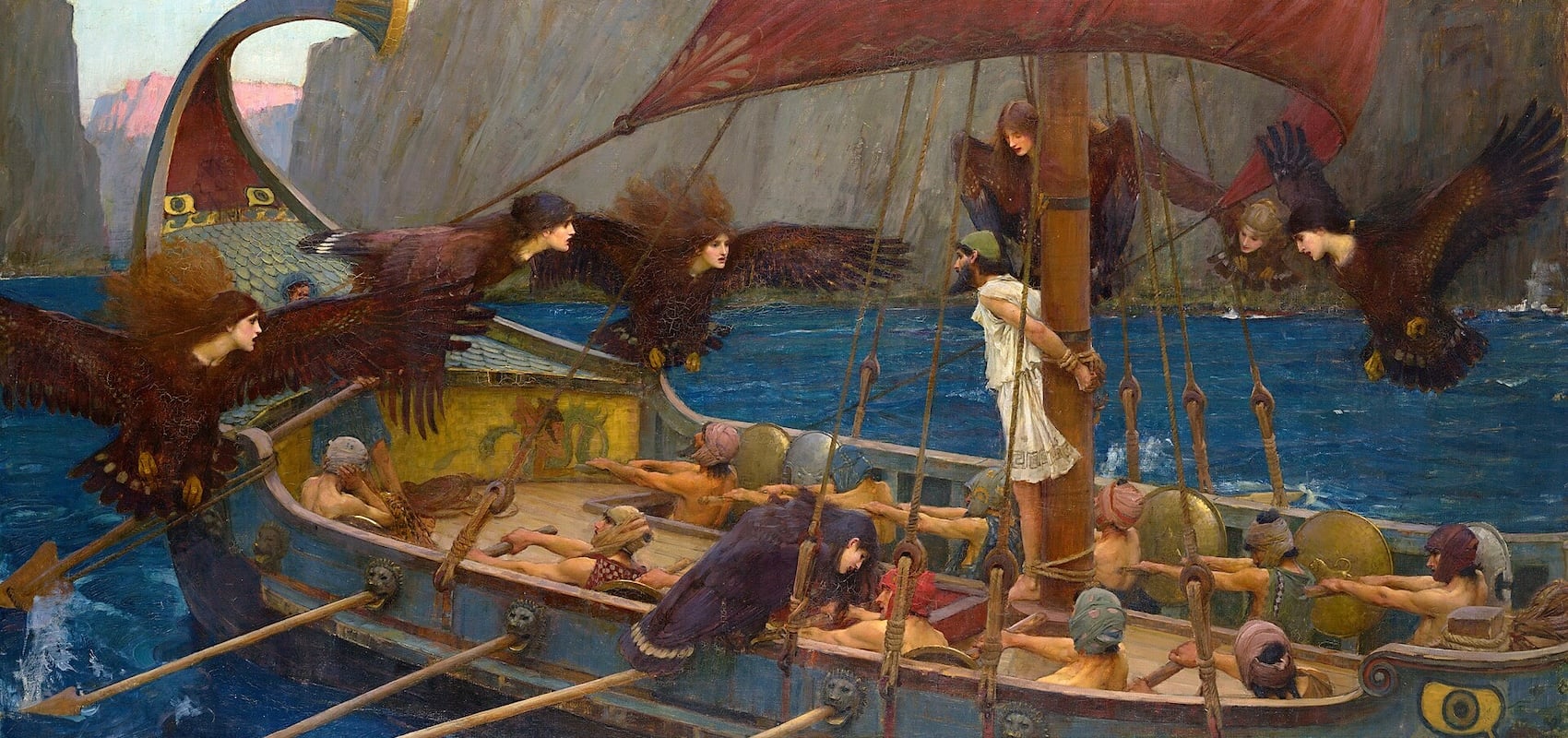
Great Books are back on everyone’s mind. Christopher Nolan is making a film about one. Many fear a sacrilege—with good reason: Nolan is reported to approve of Emily Wilson’s translation of the Odyssey, after all. And another debate on the Great Books flared up on X in recent weeks: Are the Great Books really a good education for the modern American citizen? Homer’s own response would seem to be no.
Homer’s Odyssey is a useful guide to what the classics are for and how they work. The Odyssey features many epic bards as characters, most famously Demodocus, the singer who entertains Odysseus and the Phaeacians at a great party in book 8 of the poem. Since antiquity, Demodocus was taken as a sort of riddling reference to Homer himself. According to a tradition probably stemming from this very passage, Homer was blind just like Demodocus, robbed of his sight by the Muse, but given sweet song in exchange.
Demodocus, of course, does not read from a book, nor does he seem intent on publishing his stories in writing once he has perfected them. Homer never makes reference to any book. Aside from a cryptic and debated reference in book six of The Iliad, the poems seem to depict a world entirely without writing.
Homer’s portrayals of bards—and other characters in the poems—telling various stories of heroes, and the effects they have on people, reflect his (and his oral culture’s) conception of what Homer’s epic poetry is for, and how it works. Andrew Ford’s Homer: The Poetry of the Past is a classic study on the subject. Although Homer’s world contains no books, it does not lack a concept of the classical—quite the contrary. The Indo-European oral epic tradition was likely older with respect to Homer than Homer is with respect to us.
One particular hero story sets the action of the Odyssey in motion. When a disguised Athena comes to visit Odysseus’s son, Telemachus, she listens to the youth’s complaints about the suitors and his despairing over his absent father. Telemachus, around age twenty, is old enough to be a man, but still a boy at heart. His main problem is that the patriarchy has fallen in his household and across the whole island of Ithaca. Anarchy has rushed into the void: The town council has not met at Ithaca in twenty years. Interlopers are capitalizing on the lack of strong leadership, devouring the wealth of the estate. Where are the serious men? Where are the good role models? Needless to say, this is a recurring problem in human affairs.
The goddess tells Telemachus he should consider the example of Orestes, the son of Agamemnon. Agamemnon, the leader of the Greeks at Troy, was murdered upon returning to Argos by his wife, who had been seduced by his cousin. Orestes then fled into hiding and returned a few years later to avenge his father, murdering his mother and uncle. Athena tells Telemachus, in short: This is what you must do to the suitors.
Telemachus, in other words, must become dangerous and formidable; the fate of his house depends on it. Athena very much intends the story of Orestes to be a spur to action, and it works. She leaves, and Telemachus immediately challenges the suitors—for the first time, we are to understand—calling them to account for their injustice in a public assembly.
Homer depicts here the sort of effect his own story of Telemachus’s coming of age and Odysseus’s righteous return to reestablish his household might have on his audience. The stories of heroes and their spectacular deeds are intended as a lesson, an exhortation, to the present. This is what the Greek word mythos (“discourse”) generally means in Homer: It is not a narrative in the abstract, but virtually always implies some sort of persuasive agenda, usually an exhortation. In Telemachus’s case, the heroic story is an essential aid for transforming an ill-equipped youth into a full man. Telemachus begins thereafter to become “high agency,” polytropos, like his father. Indeed, the heroic story is a stand-in for the father figure.
This is what the classical is about, for Homer. It is not concerned with books as such, nor ideas in the abstract, critical thinking, or intellectual history. Great men are what is essential, not great books. The classical exists, in short, to produce people resembling the best of its characters.
This was not the conception at the root of the Great Books movement, which was born in early-twentieth-century America. There have been many styles, to be sure, but in its more extreme forms, the Great Books approach could be fairly characterized as a disinterested romp through a series of dehistoricized texts, predominantly philosophical in nature. While teaching at St. John’s College in Annapolis in the 1950s, Seth Benardete observed how under the guidance of the dean, Jacob Klein, instructors were discouraged from making any positive statements to their students. Klein “took it as an achievement of St. John’s if somebody thought that Dante wrote in Greek. That was deliberate.”
Klein himself was a brilliant thinker and scholar, and the method he used might not be terrible preliminary training for those destined for careers as professional intellectuals. But it is not good for everyone, and is certainly not the sort of formation which shaped most of the outstanding citizens of our tradition.
The Homeric alternative is for every citizen to study the heroes of his tradition, and to take on the challenge of living up to their standard. To do this well in our world of mass literacy (such as it is) will probably necessitate reading some books, even great ones—although the term need not be capitalized. Books might be the best, but they are not the only worthwhile medium.
This is a timely charge, as we reflect upon the 250th birthday of our own Republic. We have a rich history of innovators, defenders, conquerors, reformers, and founders, possibly even an intellectual or two, ready to breathe into us that vital will to confront our present crises. We can also commit their stories to our attention on the side, while raising children, working overtime at the machine shop, or studying the history of U.S. postwar industrial policy. These heroes will prove a better guide to life than their competitors in the pop self-help genre.
When we investigate our own heroes, we will eventually be guided to their heroes as well, which include the Noble Greeks and Romans of Plutarch’s Lives, the most popular classical book in eighteenth-century America. We may realize along the way that Plutarch in fact shared Homer’s vision of the classical, and through his heroes infused our own American tradition of heroism with it as well.
That the object of our focus and vehicle of our ongoing formation should be men and not books or ideas is also a very Christian idea. Christianity, after all, was not founded on a book or idea, but on a Man. When St. Paul preached Christ, and him crucified, he had as yet no Gospels to rely on—only the Man, his story, and the Holy Spirit to guide him.
YOU MIGHT ALSO LIKE
The Best Film Ever?
Nineteen sixty-six was great for movies, and six decades later, the five nominated for Best Picture at…
A Surprisingly Subversive Sex Comedy
In his recent memoir, Communion, JD Vance talks about feeling “profoundly sad for today’s kids” navigating the…
The Possibility of Possibility
"Might could” is a Southern expression meaning “maybe I could” or “I might be able to,” conveying…
